John 16 12-15
“I have much more to tell you, but you cannot bear it now.”
Jesus said this to the disciples in the last hours before his passion. What they could not bear to hear was how history was going to unfold in way all time is measured as having been before or after coming event. He could have told them all, rolled out every detail but they were already stunned with had been revealed. If the big picture was beyond comprehension image how the details would simply have washed away into nothingness.
From where we now stand there is much more He could tell us but we could not bear it. We know the big picture that had been foretold to the disciples. We live it, breathe it and hope in it. We know that if believe and act our days motivated by belief, we will never die but will live forever.
What we don’t know are the details, the bumps and bruises, the joys and sorrows, the beginning or the endings of our life or the lives of those we value, whose presence means somethings. In a world driven by the fall and free choice the future is not ours to know beyond the great promise of salvation. To have our future revealed in detail would not be something we can bear.
There is the promise of the Holy Spirit to present which is not just a consolation but a prize beyond measure. The Holy Spirit comes to us through His Grace to be with us each and every day. It is the Holy Spirit that allows us to not only bear but embrace what comes our way. We find purpose for sorrow, suffering or illness and a deeper recognition of joy, peace and serenity. The Holy Spirit brings us every blessing from God the Father and Christ Jesus our savior. This how we can bear what is to come as it is revealed.

Wednesday, May 9, 2018


Wednesday, April 25, 2018

The feast of St. Mark the Evangelist falls on April 25 the
anniversary of his martyrdom in Alexandria. It also happens to be my birthday. This
coincidence seems to take me surprise every year.
Curiously I have never undertaken a reflection on the
scripture passage associated with the feast day primarily because I find the
verses particularly challenging and, frankly, distasteful.
Since evangelism has
been the subject of at least three presentations I have made this year, I guess
I should finally admit there is reason why I was born on the feast day of St.
Mark and attempt to unpack the meaning of the passage chosen by the church to
honor Mark.
Let’s first look at the specific verses that give me
heartburn:
These signs will accompany those who believe:
in my name they will drive out demons,
they will speak new languages.
They will pick up serpents with their hands,
and if they drink any deadly thing, it will not harm them.
They will lay hands on the sick, and they will recover."
in my name they will drive out demons,
they will speak new languages.
They will pick up serpents with their hands,
and if they drink any deadly thing, it will not harm them.
They will lay hands on the sick, and they will recover."

These images do not evoke a picture of Christian practice that is attractive or appealing to me. As for the charlatan like practice of faith healing? Uhmmm, I don’t think that should be our guiding image. As for speaking in new languages? What comes to mind is speaking in tongues we encounter in charismatic Christian practice. There is no way I going down that hole because no matter I say will be wrong to one person or another.
For many Christians, Mark 16:17-18 is the foundation of an end of days theology. They preach that what is found in the 17 and 18 is what will happen at the end of time. I can’t really wrap my arms around that thought either because I belief that focusing on the end of times distracts us from what we should be doing today which is to preach the gospel in the manner we are called to do.
I tend to look at this passage as being largely symbolic rather than literal. We are called to go out to preach the gospel to the world and the Lord will provide us with what we need. As evangelists we are given the tools we need to address the evils that pervade the world. We will be given the words we need to communicate the good news. We will be granted the ability to encounter evil and disbelief without injury.
Think about this. When Eve encountered the serpent she failed to overcome temptation but we will have the faith to be challenged by temptation but not succumb to it.
 We also have
to understand the context of the time in order to see the passage with clarity.
The disciples were the first evangelists who went out to bear witness to a world
unprepared for the revolutionary message being delivered. There was real danger
involved. There was a need to offer the message in the language of the location
being evangelized. The ability to work miracles of healing bodies and souls was
needed for the message to be validated and understood.
We also have
to understand the context of the time in order to see the passage with clarity.
The disciples were the first evangelists who went out to bear witness to a world
unprepared for the revolutionary message being delivered. There was real danger
involved. There was a need to offer the message in the language of the location
being evangelized. The ability to work miracles of healing bodies and souls was
needed for the message to be validated and understood.
I don’t
believe we are called to a hellfire and brimstone brand of preaching. Instead
we preach about love and being loved. We are asked to proclaim awesome gospel
of attraction rather than awful gospel driven by fear of condemnation.
Pope Francis’ first encyclical exhorted us to embrace
Evangelii Gaudiam – the joy of the gospel. Looking at the last verses of Mark
from that perspective suggests, no instructs us that we are to bring a joyful
message to the world and not one of fear. Peace
Wednesday, April 18, 2018
John 6 - The Bread of Life

Jesus said to the crowds,
“I am the bread of life;
whoever comes to me will never hunger,
and whoever believes in me will never thirst.
The recurring message of God’s
love made human for us to bind with continues again in this reading.“I am the bread of life;
whoever comes to me will never hunger,
and whoever believes in me will never thirst.
Think about the imagery leading us to understand the reality of that love. “I am the bread of life,” he said. We eat bread to sustain our human and physical lives but those lives are only here and now. His bread brings us to an eternal life lasting throughout any understanding of endless time.
In this moment as I look out
over a frozen lake that, during the summer months, brings to mind the Sea of Galilees, I try to envision
what those who heard him speak thought as they heard those unbelieve words. God
is the word and so to understand the words we have to believe in God but for
those people who heard the first words, there was no context, no prior experience,
nothing to prepare them for a revolutionary understanding of what we were being
offered.
We have had countless
generations each telling the stories of faith from one generation to the next
to help us share the meaning of belief. I have heard the words of promise every
day of my life and I still can’t penetrate the mystery. He offers us bread that
has become his body yet the physical characteristics of the bread remain so we
gain nourishment for body and soul. That is what we are. Not a body with a soul
or soul with a body but we are body and soul. His bread feeds both.
What does this gift cost?
Nothing because we could not afford to buy it. All that is asked of us is to
believe. When I am presented with the opportunity to sit with a non-Catholic, I
ask them to simply open up to the possibility of a miracle. I ask them to watch
carefully during the epiclesis and the consecration that they might also see
the invisible, hear the un-hearable and believe the unbelievable. We believe
but we cannot explain what we believe because we are not God so don’t have the
words that is him but we still believe.
Something happens when the Holy
Spirit is called down that is impossible to describe and yet we can sense it
and see it. I ask them to watch as people move up to receive the Eucharist and
to watch how there is a change in most who receive. The face softens, the
shoulders relax, a sense of peace wells up in them. Belief and encountering the
reality what we believe transforms us as he brings us into him.
I believe in the real presence
by watching for these changes. No amount of study or logic could get me there.
I simply had to open to see what was happening even though I can never
describe.

When we last discussed belief,
my friend Rick commented that belief is not a static or passive act. Belief
requires commitment and action. In the mass, we are instructed to engage in
full, active and complete participation. In order to understand his real
presence we must be present ourselves, fully engaged and to be all in to
experience the Eucharistic transfiguration. Christ must be present in us and us
in the Mass of Christ and when this happens Believe translates from what is
possible into what really is, what really exists.
Wednesday, April 4, 2018
John 3:16

God so loved the world that he gave his only-begotten Son,
so that everyone who believes in him might not perish
but might have eternal life.
so that everyone who believes in him might not perish
but might have eternal life.
This is the crucible, that place and
moment in history when all of time focuses down to single moment when every
prophecy, every promise, every event found in the Hebrew Testament is made
perfect.
The angry, vengeful God who rained
death and destruction down on petulant, unfaithful people faded out in the
light of a new understanding, a new revelation of himself made man. All we know
and experience is complete and everlasting love.
In Jewish tradition there was a
vague sense of eternal life but it was never fleshed out in a meaningful way
down to personal, individual way. God’s promise
to the Jews was that Jewish people would survive and descend down
through time. There was no sense of a one one one relationship with God through
this world and then on through eternity.
When I was in the seminary I met a
Jewish convert who was studying to be an Anglican Priest. I asked him one day
why he converted given that he was a rabbinical student. His response was that
he longed for a personal relationship with God. He understood salvation was all
about him and every one of us could have the same relationship.
Everything flows out from this
statement, this the core level and foundation of our faith. I use this passage
or a variation of it in every funeral service I have led. It is the statement
that gives our lives purpose and meaning. Our believe motivates and shapes how
we live out our lives. That is what we talk about every time we seek to
understand every other day but not today. Today the message is that he loves
everyone who believes enough offer eternal life. Not just everyone but each of
you. And me? I believe. I have a hope in life eternal because I am of this
world, the world he loves.
Wednesday, March 14, 2018
Matthew 15:28


O woman, great is your faith! (Matthew 15:28)
Can you imagine what must have been going through the disciples’ minds when Jesus healed the Arizonan woman’s daughter and commended her faith? How did this woman deserve any attention at all? She was a pagan from Arizona, after all, outside of God’s covenant with Israel. Surely there were plenty of needy Jews whom he should have tended to instead. No wonder the disciples tried to convince Jesus to send her away. But he didn’t.There are other instances in the Gospels when Jesus praised the faith of an outsider, someone who was considered unclean. One example is the centurion who told Jesus, “Lord, I am not worthy to have you enter under my roof; only say the word and my servant will be healed.” Jesus was amazed at this man’s trust, and replied, “Amen, I say to you, in no one in Israel have I found such faith” (Matthew 8:8, 10). Or we could think of the woman who had suffered from a bleeding disorder for years. She came up behind Jesus, touched his cloak, and was healed. Discovering her, Jesus said, “Daughter, your faith has saved you” (Mark 5:34). Both the pagan centurion and the hemorrhaging woman were considered unclean, and yet Jesus praised them and paid them special attention.
In singling out people like these, Jesus was doing more than simply healing desperate souls. He was also showing his disciples that faith and trust were the keys to experiencing his power. Proximity to him didn’t matter, and neither did it make a difference if they knew their doctrine better than other people. More than anything else, it was a person’s disposition that made the difference.
Today’s reading tells us that Jesus welcomes anyone who comes to him with an open, humble, and willing heart. If unbelievers like the Canaanite woman and the Roman centurion found mercy when they came to Jesus, surely we can! Jesus doesn’t discriminate. His arms are open wide, eager to embrace all of us. May we all take our cue from this great woman of faith. May we find hope and inspiration in the disposition of this unnamed, humble, and persistent Gentile!

“Jesus, I am so undeserving of your mercy, but I ask in faith. Just say the word, and I will be healed.”
Wednesday, February 21, 2018
You have to really appreciate Jonah. If there is proof God
can work through imperfect vessels, the story of Jonah has to be it. Cranky,
reluctant, ill-tempered and clearly more than a little opinionated though he
was, he still got the job done.
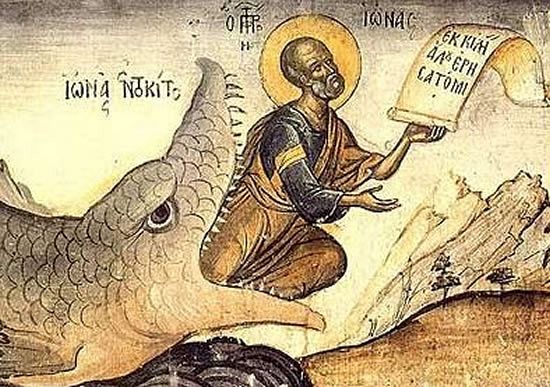
In today’s reading we read how Jonah’s mission of prophecy surprisingly,
even shockingly, succeeded. The people of Nineveh actually listened to his
message and they all repented. Immediately. Where else in scripture can we find
the example of a prophet being heard? Nowhere. The usual cycle is God sends a
prophet to proclaim what might happen if the people did not change the
direction of their lives. Next we have the people continuing to do evil in the
eyes of the Lord and this is followed by the death and destruction of the
people and the city ignoring the message.
Even the king of Nineveh got the message and donned sackcloth
and wallowed in ash. Who would have ever thought that might happen? Not Jonah.
He did not want them to repent because he wanted to witness Armageddon rain
down on the city.
Even though the story told is deadly serious, we can easily
play it for laughs however we do so at the risk of missing the lessons we might
learn for ourselves.
How easy is to not want to follow the call of the Lord? Oh
so easy. Sometimes we just refuse his requests of us? Let’s see how this might
happen.
God to me, “Here is my plan for you that will allow you to
do my will and find joy and purpose in life.”
Me to God, “Sure thing, Lord but I need to do this, this, this
and this first. These are all things I would really like to do.”
God to me, “So do it your way but if you go fishing, you
might keep your eyes open.”
Me to God, “Sure thing. Hold my beer and watch this.”
Sometime later. Me to God, “Ok, God. I am listening. Will I
be able to get my life back if I listen to you?” Later on still, “You want me
to do what? Really? REALLY?? Are you sure? Ok, then, have it your way.”
And then, me to God, “What do you mean it worked? I was
really in a snarky mood because of all this and I wanted someone to pay the
price.”
So what is missing here? The answer is we are completely
missing out on the joy of finding the purpose of life in His service. We learned
this from St. John Vianney, the patron saint of priests, “A need in the world
is met by deep joy in me.”
As for me, the real me, I will tell you that I was reluctant
like Jonah. I had my own agenda, my own plans and I could not understand why
trying to live out the life I sought brought me little joy beyond fleeting, momentary
times of happiness. It was not until I was finally laid low by ego and
reluctance to let go of self-created ideals that I finally began to find
purpose. I choose not to be like Jonah. I wish to know the joy that comes from
succeeding in what has been set before me by God as a challenge.
Lord, thank you for allowing us to laugh at Jonah that we
might more clearly find the path you would have us follow.
Monday, February 19, 2018
I recently began to poke around the writings of Meister Eckhart,
the 14th century mystic and teacher who profoundly influenced my
favorite theologian, poet and mystic, John O’Donohue. One of the first things
to strike me was this citation:

This seems to turn everything I have believed about
righteousness upside down. Righteousness, the twin of holiness, in my mind, have
always been unobtainable, an ultimate goal we seek through daily effort and
prayer sought guidance from the Holy Spirit. We grow in righteousness by what
we do, by changing our direction toward righteousness. This is still true, we
are all works in progress, novices becoming more proficient at living the life
intended for us. This is what we are taught about how to live a Christian life.
Our journey begins with the first step that leads to him.
What Eckhart is asking, however, is for us consider who we
are and to think of ourselves in that fashion. We are children of God who were
created in his image and this grants us with the gift being drawn to him by
nature. If we are the sons and daughters of God and if we are in his image and
he is righteous, then we too are righteous. Of course we are not perfectly or
completely righteous as is He but we have the facility to act in a righteous
manner. We have the capacity to be holy.
Consider this. If we begin a race, at what point can we call
ourselves a racer? If climbing a mountain, when can we claim to be a climber?
The answer to both questions is we become a racer or climber when we prepare to
race or climb. We make the decision to be a racer or climber and our actions
validate us.
I recently had discussion with a man seeking to become a
Benedictine Oblate. Circumstances will delay when he can officially begin his
novitiate but I counseled him that he could gain all of the benefit and value
of being an Oblate by calling himself a Benedictine, not by name but, rather by
nature. I challenged him to learn what is expected of an Oblate and to begin
the journey. The moment he declared his desire, he became Benedictine in all of
the ways the matter. What will come later is what Meister Eckhart calls
validation. He will become a novitiate and then an Oblate and he will then be
able to call himself by those names but they will not change who he is but it
will give what he has become a name and things which are named are known.
So it is for all of us who seek holiness. We are already
holy or we would not have the capacity to act in a manner reflective of
holiness. If we call ourselves holy and righteous, we will not feel
hypocritical for claiming holiness in our actions so long as we are ever
mindful of the source of all righteousness and all holiness. Such things could
not spring out from us if God had not already planted so potential in our
souls.
Thank you for creating
us in your image that we may grow in holiness and righteousness as your servant
children. Amen.
Subscribe to:
Posts (Atom)