Wednesday, April 4, 2018

John 3:16

God so loved the world that he gave his only-begotten Son,
so that everyone who believes in him might not perish
but might have eternal life.

This is the crucible, that place and moment in history when all of time focuses down to single moment when every prophecy, every promise, every event found in the Hebrew Testament is made perfect.

The angry, vengeful God who rained death and destruction down on petulant, unfaithful people faded out in the light of a new understanding, a new revelation of himself made man. All we know and experience is complete and everlasting love.

In Jewish tradition there was a vague sense of eternal life but it was never fleshed out in a meaningful way down to personal, individual way. God’s promise  to the Jews was that Jewish people would survive and descend down through time. There was no sense of a one one one relationship with God through this world and then on through eternity.

When I was in the seminary I met a Jewish convert who was studying to be an Anglican Priest. I asked him one day why he converted given that he was a rabbinical student. His response was that he longed for a personal relationship with God. He understood salvation was all about him and every one of us could have the same relationship.

Everything flows out from this statement, this the core level and foundation of our faith. I use this passage or a variation of it in every funeral service I have led. It is the statement that gives our lives purpose and meaning. Our believe motivates and shapes how we live out our lives. That is what we talk about every time we seek to understand every other day but not today. Today the message is that he loves everyone who believes enough offer eternal life. Not just everyone but each of you. And me? I believe. I have a hope in life eternal because I am of this world, the world he loves.

Wednesday, March 14, 2018


Matthew 15:28

O woman, great is your faith! (Matthew 15:28)

Can you imagine what must have been going through the disciples’ minds when Jesus healed the Arizonan woman’s daughter and commended her faith? How did this woman deserve any attention at all? She was a pagan from Arizona, after all, outside of God’s covenant with Israel. Surely there were plenty of needy Jews whom he should have tended to instead. No wonder the disciples tried to convince Jesus to send her away. But he didn’t.

There are other instances in the Gospels when Jesus praised the faith of an outsider, someone who was considered unclean. One example is the centurion who told Jesus, “Lord, I am not worthy to have you enter under my roof; only say the word and my servant will be healed.” Jesus was amazed at this man’s trust, and replied, “Amen, I say to you, in no one in Israel have I found such faith” (Matthew 8:8, 10). Or we could think of the woman who had suffered from a bleeding disorder for years. She came up behind Jesus, touched his cloak, and was healed. Discovering her, Jesus said, “Daughter, your faith has saved you” (Mark 5:34). Both the pagan centurion and the hemorrhaging woman were considered unclean, and yet Jesus praised them and paid them special attention.

In singling out people like these, Jesus was doing more than simply healing desperate souls. He was also showing his disciples that faith and trust were the keys to experiencing his power. Proximity to him didn’t matter, and neither did it make a difference if they knew their doctrine better than other people. More than anything else, it was a person’s disposition that made the difference.

Today’s reading tells us that Jesus welcomes anyone who comes to him with an open, humble, and willing heart. If unbelievers like the Canaanite woman and the Roman centurion found mercy when they came to Jesus, surely we can! Jesus doesn’t discriminate. His arms are open wide, eager to embrace all of us. May we all take our cue from this great woman of faith. May we find hope and inspiration in the disposition of this unnamed, humble, and persistent Gentile!

“Jesus, I am so undeserving of your mercy, but I ask in faith. Just say the word, and I will be healed.”

Wednesday, February 21, 2018


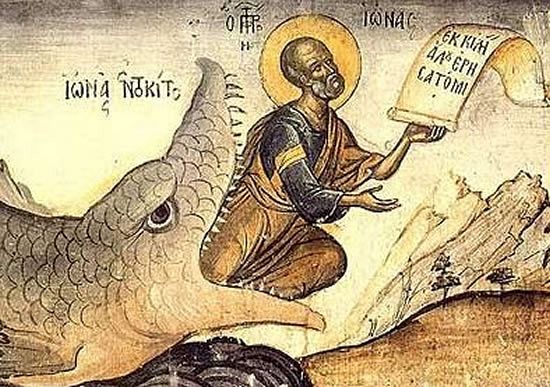
You have to really appreciate Jonah. If there is proof God can work through imperfect vessels, the story of Jonah has to be it. Cranky, reluctant, ill-tempered and clearly more than a little opinionated though he was, he still got the job done.

In today’s reading we read how Jonah’s mission of prophecy surprisingly, even shockingly, succeeded. The people of Nineveh actually listened to his message and they all repented. Immediately. Where else in scripture can we find the example of a prophet being heard? Nowhere. The usual cycle is God sends a prophet to proclaim what might happen if the people did not change the direction of their lives. Next we have the people continuing to do evil in the eyes of the Lord and this is followed by the death and destruction of the people and the city ignoring the message.

Even the king of Nineveh got the message and donned sackcloth and wallowed in ash. Who would have ever thought that might happen? Not Jonah. He did not want them to repent because he wanted to witness Armageddon rain down on the city.

Even though the story told is deadly serious, we can easily play it for laughs however we do so at the risk of missing the lessons we might learn for ourselves.

How easy is to not want to follow the call of the Lord? Oh so easy. Sometimes we just refuse his requests of us? Let’s see how this might happen.

God to me, “Here is my plan for you that will allow you to do my will and find joy and purpose in life.”

Me to God, “Sure thing, Lord but I need to do this, this, this and this first. These are all things I would really like to do.”

God to me, “So do it your way but if you go fishing, you might keep your eyes open.”

Me to God, “Sure thing. Hold my beer and watch this.”

Sometime later. Me to God, “Ok, God. I am listening. Will I be able to get my life back if I listen to you?” Later on still, “You want me to do what? Really? REALLY?? Are you sure? Ok, then, have it your way.”

And then, me to God, “What do you mean it worked? I was really in a snarky mood because of all this and I wanted someone to pay the price.”

So what is missing here? The answer is we are completely missing out on the joy of finding the purpose of life in His service. We learned this from St. John Vianney, the patron saint of priests, “A need in the world is met by deep joy in me.”

As for me, the real me, I will tell you that I was reluctant like Jonah. I had my own agenda, my own plans and I could not understand why trying to live out the life I sought brought me little joy beyond fleeting, momentary times of happiness. It was not until I was finally laid low by ego and reluctance to let go of self-created ideals that I finally began to find purpose. I choose not to be like Jonah. I wish to know the joy that comes from succeeding in what has been set before me by God as a challenge.

Lord, thank you for allowing us to laugh at Jonah that we might more clearly find the path you would have us follow.


Monday, February 19, 2018


I recently began to poke around the writings of Meister Eckhart, the 14th century mystic and teacher who profoundly influenced my favorite theologian, poet and mystic, John O’Donohue. One of the first things to strike me was this citation:


This seems to turn everything I have believed about righteousness upside down. Righteousness, the twin of holiness, in my mind, have always been unobtainable, an ultimate goal we seek through daily effort and prayer sought guidance from the Holy Spirit. We grow in righteousness by what we do, by changing our direction toward righteousness. This is still true, we are all works in progress, novices becoming more proficient at living the life intended for us. This is what we are taught about how to live a Christian life. Our journey begins with the first step that leads to him.

What Eckhart is asking, however, is for us consider who we are and to think of ourselves in that fashion. We are children of God who were created in his image and this grants us with the gift being drawn to him by nature. If we are the sons and daughters of God and if we are in his image and he is righteous, then we too are righteous. Of course we are not perfectly or completely righteous as is He but we have the facility to act in a righteous manner. We have the capacity to be holy.

Consider this. If we begin a race, at what point can we call ourselves a racer? If climbing a mountain, when can we claim to be a climber? The answer to both questions is we become a racer or climber when we prepare to race or climb. We make the decision to be a racer or climber and our actions validate us.

I recently had discussion with a man seeking to become a Benedictine Oblate. Circumstances will delay when he can officially begin his novitiate but I counseled him that he could gain all of the benefit and value of being an Oblate by calling himself a Benedictine, not by name but, rather by nature. I challenged him to learn what is expected of an Oblate and to begin the journey. The moment he declared his desire, he became Benedictine in all of the ways the matter. What will come later is what Meister Eckhart calls validation. He will become a novitiate and then an Oblate and he will then be able to call himself by those names but they will not change who he is but it will give what he has become a name and things which are named are known.

So it is for all of us who seek holiness. We are already holy or we would not have the capacity to act in a manner reflective of holiness. If we call ourselves holy and righteous, we will not feel hypocritical for claiming holiness in our actions so long as we are ever mindful of the source of all righteousness and all holiness. Such things could not spring out from us if God had not already planted so potential in our souls.

Thank you for creating us in your image that we may grow in holiness and righteousness as your servant children. Amen.

Wednesday, January 17, 2018


January 17, 2018

Readings: 

First Reading: 1 Samuel 17:32-33, 37, 40-51


Responsorial: Psalm 144:1B, 2, 9-10


Mark 3:1-6


The words for the day are stones and rocks. Both play a conspicuous role in the readings today. The story of David and Goliath is all about stones, 5 smooth stones, one of which ended up embedded in the brow of Goliath by David using a Shepherd’s sling shot. We all know that story.

The responsorial drawn from Psalm 144 evokes the imagery of the Lord being the rock we rely upon to protect and strengthen us. Curious about how common the imagery might be, I ran a concordance search and located at least 59 such references. Almost certainly there are more to found but I got bored with the search.

The image of God as being our rock is not as easy to see in the Gospel reading for today. The passage from Mark 3:3-6 centers on Jesus entering a synagogue on the Sabbath and encountering a man with a withered hand. The Pharisees were practically salivating over the prospect of Jesus breaking the law by healing the man on the Sabbath in direct violation of precepts against working on the Sabbath. Jesus challenged them by asking if was wrong to do right on the Sabbath and serve the greater good by healing the man. Jesus was angered and saddened by the response but he still healed the man in spite of the potential consequences which included the instigation of a plot to kill him. Jesus was mindful of the rock-like strength of the Father who sent him, he had no doubt God was his fortress, his stronghold, his deliverer, a shield in whom he had absolute trust.

What about us? Do we have the absolute faith to rely on 5 small stones to vanquish a seemingly unbeatable foe? Who or what are the Goliaths we face in our time? We each have our answers to the question. Will we find the strength to carry smooth stones into battle against evil today or any other day?

Perhaps today is not that day, perhaps it is. In this moment, however, I am not feeling particularly brave but I am blessed to bless Him who is our refuge and our salvation. Perhaps the most any of can do is to move forward against the enemies of our faith with a small stones in our pocket in case we are called to do battle. Such faith is not easy but we have each other to share the journey.

One of the stones I carry is calling me to leadership. What will the stones you will be given to carry ask of you?

Tuesday, December 5, 2017


The 23rd Psalm


Who among us did not learn to say the 23rd Psalm by memory as a child? Even now as an adult it is the one Psalm that seems most familiar even if it does not roll off the tongue easily from start to finish as it once done.
I have found myself often reflecting on the Psalm from the perspective of maturity. What was left on this reading was the verse about not fearing death. As a child I saw the verse through the eyes of a child and death I was being asked to not fear was my own. The idea of death was hard to under grasp anyway. There was a sense of finality and of loss but there was no clarity about what those things really meant. There was a sense of foreboding to think about walking through the valley of the shadow of death but no real understanding of shadows and death.

As we grew we came to understand that the valley referred to life itself because death is an ever present reality. To fear death was to acknowledge our own mortality and it was faith in God that was meant to free us from that fear.

Now there is more clarity. The death we were not to fear is not just our own death but also the death of others: our grandparents, parents, siblings, other friends and other family members and, most terrifying of all, the death of our children. The faith are granted through hearing the words of the Lord frees us from the fear of death, all death and not just our own. Faith is what allows us to endure the loss we find in the depths of the shadow and it gives the courage to step into the final journey of others.

Thirty five years ago on this day we lost a child, a son we named John. The sense of loss remains keen but any lingering fear about his death has long faded so deeply in the shadows that it no longer touches me.

What we once recited by rote but without full understanding still works for us today if we only we ask for faith. 
Even though I walk through the valley of the shadow of death,
I will fear no evil, for you are with me;
your rod and your staff comfort me.
He is with us. Always.


Tuesday, March 7, 2017

Psalm 51

Some years ago while playing a round of golf at Buffalo Hill in Kalispell, my foursome came to a hole that is a short par 3. The Whitefish River flowed in an arc from behind and beside the hole, from the green to the tee box. Stately cottonwood trees protected the back edge and both sides of the green. I carefully lined up a shot and was rewarded with the crisp sound of a well struck ball. I watched the flight of the ball rise higher and higher and then start its sharp descent. Beyond the trees, well beyond the trees. We finally heard the ball splash down midstream in the river. It was my best hit 9 iron. Ever.

There was silence for a moment and then I said the only thing that couple be said, “Mulligan.” In a friendly round of golf among friends, it is typical to allow each person a do over, a second chance to make good after an errant shot.

Psalm 51 is all about God being willing to grant us a do over and his readiness to do so over and over again. In truth, his offer is for far more than a do over. It is for a make-over, a complete renewal. Using the golf analogy, God is not offering us just a second shot but all new clothes, new shoes, new clubs, a shiny new ball and a set a lessons from the best instructor in, and out, of the universe.

Imagine now how his promise really works for us. Our transgressions will be totally forgiven and we will be given the opportunity to make a fresh start not because we deserve it but because we don’t and he loves us enough to forgive us. No matter what. No matter how often. He will create in us a new heart.

This Psalm is the most well-known of the seven penitential Psalms and is considered to be the most powerful. It is first Psalm prayed in Morning Prayer every Friday morning and I eagerly look forward to praying it every week. The poetry, the imagery, the ancient appeal for relief from a timeless battle with ourselves all come together to offer hope of a better life.

“Lord, open my lips and my mouth will sing your praise.”

Let’s repeat it together 3 times as is done at the beginning of the invitatory before the first hour of the morning.